
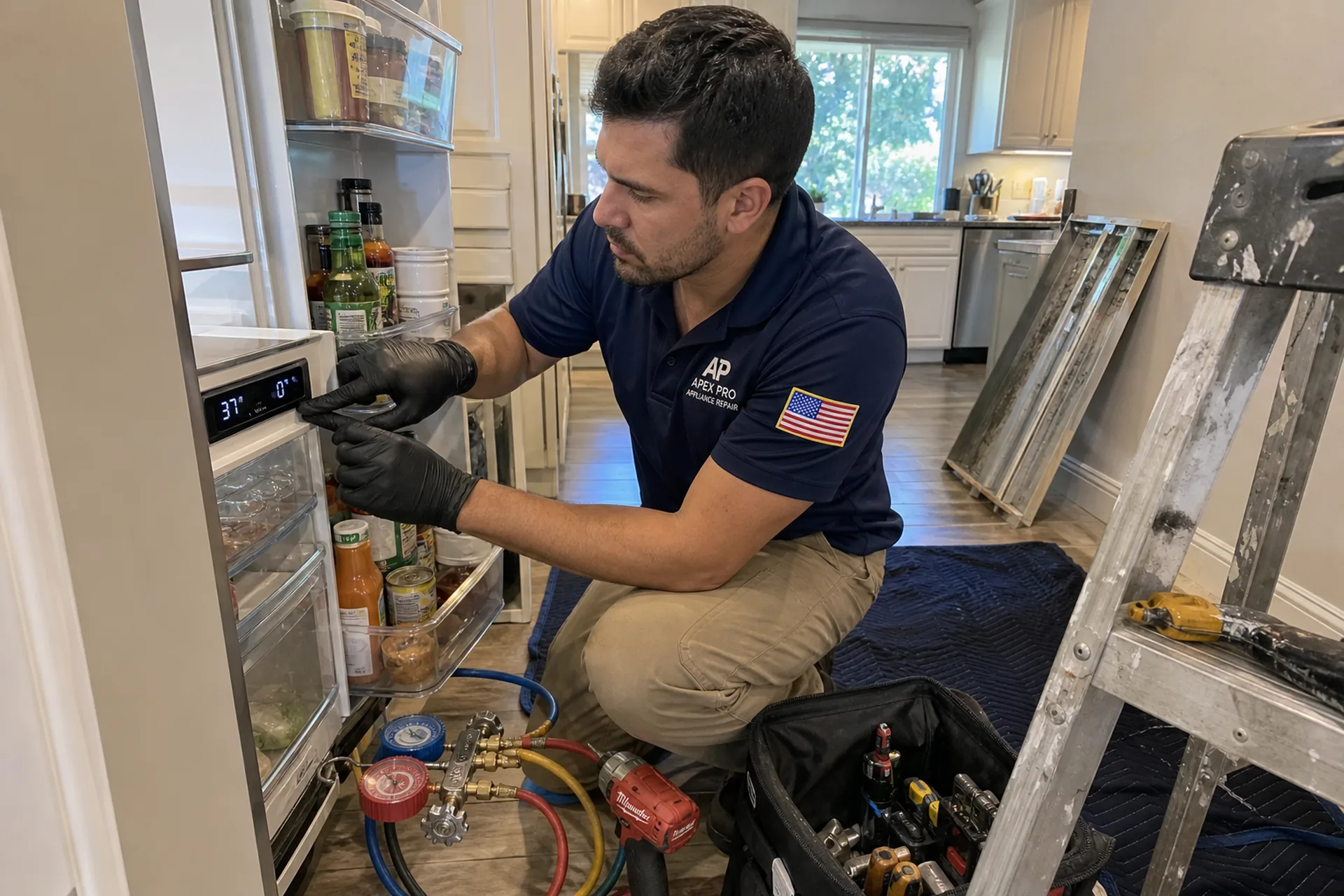
A Sub-Zero that has stopped cooling feels like a bigger problem than it usually is. These are serviceable appliances, built into the room and designed to be repaired rather than replaced, and the cause is almost always one of a short list.
Here is that list, in roughly the order our technicians work through it on a call in Los Angeles.
1. The Condenser Is Choked with Dust
This is the single most common cause, and the most avoidable one. The condenser sits behind the grille at the top of most built-in Sub-Zero units, and it needs clean airflow to shed heat. In an LA home with pets, open windows or a nearby remodel, it packs with dust far faster than most owners expect.
A blocked condenser does not stop the refrigerator outright. It makes it run long, cool poorly, and struggle most on hot days — which is exactly the pattern people describe when they call in August.
What you can do: switch the unit off, take the grille off, and vacuum the condenser coil thoroughly. If cooling recovers over the next several hours, that was it. Put it on the calendar to repeat.
2. Only One Sealed System Has Failed
Most built-in Sub-Zero refrigerators use dual refrigeration: two completely separate sealed systems, one for the fresh food section and one for the freezer. It is the reason produce keeps so well in them, and it is also the reason a Sub-Zero can fail in a way that seems illogical.
If your freezer is rock solid and the refrigerator side is drifting warm, that is not a mystery — it is a fault isolated to one of the two systems. The reverse happens too.
What it means: the diagnosis has to be done per system. A technician testing only one half of the unit will come to the wrong conclusion.
3. The Evaporator Fan Motor Has Stopped
Cold air has to be moved. If the evaporator fan in the affected section has failed, the coil still gets cold but almost none of that cold reaches the cabinet. The symptom is a compartment that is warm while the coil behind the panel is iced solid.
Sometimes you can hear it: a unit that has gone noticeably quieter, or one that develops a rattle or a whine before it stops altogether.
4. A Defrost Fault Has Let the Evaporator Ice Over
Every frost-free refrigerator runs a defrost cycle to clear the evaporator coil. When the defrost heater, the defrost thermostat or the control circuit that triggers them fails, frost builds until it blocks airflow across the coil completely.
The tell is a gradual decline rather than a sudden one — the section gets a little warmer each day, and if you can see the back panel there is heavy frost behind it. Turning the unit off overnight often restores cooling temporarily, which confirms the diagnosis but does not fix it.
5. The Door Is Not Sealing
Gaskets harden with age, and on a panel-ready unit a heavy custom door front can pull the alignment out over time. A seal that looks fine can still be letting warm room air in continuously, which means the unit never stops working and the temperature never quite settles.
What you can do: close the door on a dollar bill and pull. If it slides out with no resistance, the seal at that point is not doing its job. Try it at several points around the door.
6. The Control Board or a Sensor Is Misreading
Sub-Zero units make decisions based on thermistors reading the actual cabinet temperature. If a sensor drifts or the control board misinterprets it, the unit can behave as though everything is fine while the compartment is well above where it should be — or run continuously chasing a temperature it has already reached.
Stored service codes and the unit’s own diagnostic mode usually point straight at this, which is why a technician will check them before touching anything mechanical.
7. A Genuine Sealed-System Fault
Least common, most serious: a refrigerant leak, a restriction, or a compressor that is no longer pumping properly. Diagnosis needs manifold gauges and proper recovery equipment, and the repair needs both the leak found and the system evacuated and recharged correctly.
This is real work, but on a built-in unit it is frequently still worth doing. Replacing a built-in means cabinetry as well as an appliance.
What to Check Before You Call
- Vacuum the condenser and give the unit several hours to recover.
- Confirm nothing inside is blocking the interior air vents.
- Check the door seal with the dollar-bill test.
- Note which section is failing, and whether the display is showing anything.
Those four pieces of information turn a vague call into a specific one, and they often let us bring the right part on the first visit.
When to Stop and Get a Technician Out
If the fresh food section is sitting above 40°F and has not recovered after clearing the condenser, the clock is running on everything inside it. Anything involving the sealed system, the defrost circuit or the control board needs a technician with the right tools — guessing at those parts gets expensive quickly.
ApexPro is a mobile service, so a technician comes to your kitchen, diagnoses the unit in place, and gives you the price before any work begins. Sub-Zero is the specialty on our logo, and built-in refrigeration is what we do most.